Friday, 4 April 2014

Discovering the RPS Archive

My first visit to the Royal Philharmonic Society’s archive; a wealth of scores, letters, papers and miscellanea that trace its 200-year history of music-making and commissioning, was well overdue. In truth, my overriding memory of archives is of long hours spent in search of the magic document which would transform my thesis into a revelatory masterwork (alas, it proved elusive). However, even a superficial exploration of the RPS collection, under the expert guidance of RPS council member and British Library curator Nicolas Bell (and free of impending deadlines), offered a fascinating window on UK concert performance history.

Sold to the British Library in 2002, and so providing the RPS with the stable financial foundation it had lacked throughout its past, the collection is now housed in the library’s cavernous basement, which extends to a depth of over 24 metres. A conveyor belt system whirrs overhead as publications (the library owns over 150 million in total) are ferried across the building. Among the 270 scores in the RPS archive is the autograph manuscript of Mendelssohn’s First Symphony, which the composer presented to the Society after giving the work’s premiere with them in 1829. The collection also includes autographs by nineteenth-century composers who have stood the test of time less well: Ignaz Pleyel, Cherubini, Sigismund Neukomm, Spohr, Cipriani Potter and William Sterndale Bennett.

Musician fees among the financial papers
Equally revealing are the documents relating to the day-to-day running of the Society. Minutes which (once you have deciphered the fountain pen scrawl) describe, for example, concern over whether or not to invite Richard Wagner to conduct the orchestra in 1855. (He came, but the experience was mutually disagreeable.) From a seemingly insignificant list of the Society's orchestral players, it is possible to gauge a surprising amount about the orchestra in the early nineteenth century, from the quantity, hierarchy and fees of the players, to the Germanic and Italian names suggesting musicians who had come from abroad.

A lock of hair from Ludwig
There’s also some downright weird stuff, such as the strands of Beethoven’s hair gifted to the Philharmonic Society; one of many keepsakes taken from the composer's death bed. Of far more historical significance is the score of his Ninth Symphony, sent by Beethoven to the Society in 1824. It carries his autograph dedication to the society and the copyists’ work is liberally corrected in Beethoven’s hand. Other composers had a less productive relationship with the Society. I stumbled across a letter from a young and relatively unknown Edward Elgar, who was ‘naturally anxious to obtain a hearing in London at the Philharmonic’. The response clearly displeased him; a subsequent letter affirmed ‘I, of course, do not intend to “submit” any composition of music to the judgement of your “Directors” (although the relationship would later flourish with Elgar’s rising success). 


With such treasures, the RPS archive provides an important record of repertory and performance practice, and of historic decisions regarding the Society’s role, membership, commissions and collaborations - decisions which continue to be made today. Who knows what researchers will be uncovering in the RPS archive another two hundred years down the line...  

Helen Pearce

With thanks to Nicolas Bell and the British Library

Discover more on the RPS website

Monday, 30 December 2013

Beethoven Bust Reflects on the Bicentenary


With András Schiff at Wigmore Hall
Schaller’s iconic bust of Beethoven was given to the RPS (then the Philharmonic Society) in 1870 by Fanny Linzbauer in recognition of its generosity towards Beethoven in times of need. It was displayed on the concert platform of every Society concert thereafter; a tradition which was re-established this year as part of the RPS Bicentenary celebrations.

As 2013 draws to a close, we catch up with the Beethoven Bust to see what he made of it all...


Beethoven Bust, it's been quite a year.

It has indeed. It's incredible to think all the way back to our launch party with Alfred Brendel at the Argyll Arms pub. We recently rounded off the Bicentenary celebrations at Wigmore Hall with another world-renowned pianist; on 21 December the RPS Gold Medal was awarded to András Schiff after his 60th Birthday Recital. I'm so glad that the presentation is available to watch online. I think the cameraman caught me from my good side!

It sounds like quite a night. I hope you’ve been enjoying a well-earned break over Christmas.

Yes, I even got a Christmas present! The RPS gave me a bag of chocolate coins. I think they were alluding to the fifty pounds they gave me back in 1822 to commission my Ninth Symphony. I’ve increased my rates since then, though.

We won’t expect a new piece from you any time soon. What have been your highlights from the Bicentenary year?

That’s a very tricky question! Hearing so many new commissions, both by established composers and from younger composers at the start of their career has been really inspiring. 22 composers were commissioned by the RPS to write new pieces in 2013; the most in any year since I've been around! 
The BBC Prom in August with the fantastic National Youth Orchestra and National Youth Choir of Great Britain was definitely a stand-out moment for me. 


On stage with Vasily Petrenko and the NYO at the BBC Proms
Could that have anything to do with the fact they were performing your Ninth Symphony?

Well, it does seem to have aged well (just like me). But Frieze, an RPS co-commission from Mark-Antony Turnage which they performed first, had me spellbound.

And the same programme travelled to New York in the Autumn for sell-out performances by the New York Philharmonic Orchestra?

So I hear! Sadly I didn’t make it across the Atlantic as well – my passport’s a century or two out of date. I have been appearing at RPS concerts and events all around the UK though – Manchester, Poole, Birmingham… It’s like the old days between 1871 and the last RPS concert series in the 1980s, when I always stood on the concert platform.

Fantastic! So over time you’ve become a much-loved icon of musical excellence and support for the living composer – two causes at the heart of the work and ethos of the RPS.

Sounds about right – and I’m back by popular request.

But the RPS Bicentenary year is coming to an end. Does this mean you’ll be retiring from public life again now?

I may take things a little slower, but I’ll be making the odd guest appearance. Besides, I still have my Twitter feed @beethoven_bust to manage!


Your Pinterest page is looking pretty healthy too. Who would have thought…

Friday, 8 November 2013

RPS Young Musicians Recital - 7 November 2013

A special recital hosted by Sir Vernon and Lady Ellis offered the opportunity to hear and meet some of the outstanding young performers supported by the Royal Philharmonic Society. The beautiful drawing room of 49 Queen's Gate Terrace provided an intimate setting for performances by the Wu Quartet, cellist Ariana Kashefi and pianist Richard Uttley, all current beneficiaries of the RPS Young Musicians Programme.

As RPS Executive Director Rosemary Johnson explained, there is no simple or clear path for a musician who is graduating from college and establishing their professional career. Acknowledging this, the RPS Young Musicians Programme provides comprehensive and tailored support to exceptional artists throughout and beyond their training. In conversation with Rosemary following a spirited performance of Mendelssohn and Janacek, members of the Wu Quartet explained how their RPS Albert and Eugenie Frost Prize is helping them to expand their development and performance opportunities. The prize enables them to travel to and from Germany, where the quartet is being mentored by Hatto Beyerle, former member of the Alban Berg Quartet and founder of the European Chamber Music Academy.

Germany is clearly the destination of the moment. 2013 RPS Julius Isserlis Scholar Ariana Kashefi will be using her grant to fund a two year Masters course at the Hanns Eisler Music Academy in Berlin. If the experiences of fellow Julius Isserlis Scholarship winner Emily Hoile are anything to go by (read her blog post here!), or indeed the career of the scholarship's first-ever recipient Stephen Hough; studying abroad is a fantastic opportunity to broaden one’s horizons. Ariana’s distinguished performance of Schumann’s Drei Fantasiestücke certainly suggested a promising future. With pianist Alison Rhind, she sensitively negotiated the dramatic mood changes so characteristic of Schumann’s music.


Richard Uttley was joined by Rolf Hind, his mentor on the Philip Langridge Mentoring Scheme, to perform the piano duet Ma Mere L’Oye. Composed by Ravel in 1910, it is more familiar to many listeners as the orchestrated version which he completed the following year before expanding the work into a ballet. The rapport between Richard and Rolf, in addition to their outstanding technique and musicianship, bodes well for PULSE, the Royal Philharmonic Society’s new music and film commission for the PRS for Music Foundation’s New Music Biennial in 2014. The pair will be joined by two percussionists and two gamelan players to perform Dobrinka Tabakova’s score. With this and so many projects in the pipeline for all of these young musicians, the concert was a taste of great things to come.

Helen Pearce 

Friday, 23 August 2013

Studying Abroad with the RPS Julius Isserlis Scholarship

The RPS Julius Isserlis Scholarship offers young musicians the unique experience of studying abroad. Many grant winners have gone on to have fantastic careers - not least the very first recipient of the award, pianist Stephen Hough, whose grant assisted his Master's studies at the Juilliard School. 

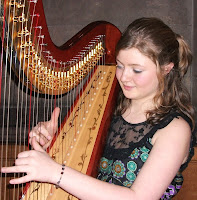
Following in his footsteps is harpist Emily Hoile, who also chose to study at New York's Juilliard School with the help of a £10,000 Julius Isserlis grant in 2011. A second award from this year's Julius Isserlis Scholarship enables her to complete her studies there. 

Recently, we caught up with Emily to find out how life across the Atlantic has been treating her.

HP What attracted you to the Juilliard School in particular?

EH The main reason I applied to Juilliard was because of the harp teacher there, Nancy Allen, who is the principal harpist of the New York Philharmonic. One of my favourite recordings that I owned was of her playing the Ginastera harp concerto so from there I found out that she taught at Juilliard! Besides Nancy, I think one of the things that really stood out to me about Juilliard was the range of performing arts that people study there. Along with having a fantastic music department, they have equally inspirational drama and dance divisions.

HP What repertoire are you working on at the moment? 
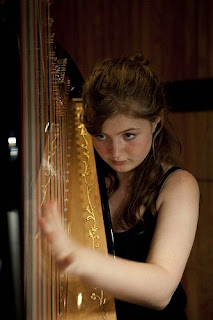
EH I have just taken part in the USA International Harp Competition so for the past few months I have been pretty much exclusively working on the repertoire for that. It encompassed some of the well know standard pieces of harp repertoire such Fauré's Impromptu for harp and Reinecke's Concerto, but besides that there were some lesser well known harp works: transcriptions of Scarlatti sonatas for example, as well as a 40 minute recital of your own choice of music. As part of that I have transcribed a couple of works - my favourite is 'Wiegenlied' by Strauss, originally for soprano with piano accompaniment. I think there's just something quite special about the way it works with the sound and resonance of the harp. At the moment I'm thinking about what new pieces to learn this year so am having fun just reading through a lot of music, from the standard harp repertoire as well as some possible piano transcriptions!

HP What do you most enjoy playing?

EH I really enjoy playing a lot of different styles of music. Since studying at Juilliard I've discovered that I really love playing modern music, either solo or in an ensemble. I think as a harpist it's quite easy to be in your own bubble of solo harp music with it's distinctive style, that to be in a group, playing extremely challenging music both harmonically and rhythmically, where everyone has to be 100% committed is really refreshing.  Later this month I'm really excited to be going to Finland to perform with Juilliard's new music ensemble 'Axiom' and musicians from the Sibelius Academy conducted by Susanna Malkki. 

HP What have been the highlights of your time at Juilliard so far?

EH There have been so many! Getting the chance to perform 'sur Incises' by Boulez in my second year was incredible - a mammoth 40 minute work for three pianists, three percussionists and (most importantly, obviously) three harpists. That was probably one of my favourite, and most challenging ensemble concerts that I've ever played. Also, earlier this year I organised a collaborative performance of Caplet's 'Le Conte Fantastique' for harp and string quartet. It's a piece based on the Edgar Allen Poe story 'The Masque of the Red Death' so we had a student narrate as we went along, as well as four dancers in my year who choreographed certain sections to heighten the drama. It was really fantastic getting to work with students from the other divisions in the school and learning how they work and think. It's fascinating.

HP New York is a long way to take a harp! How have you managed the distance in terms of transporting your instrument?

EH I have been very lucky, in that Juilliard owns ten harps that the harp students can use at any time. Whilst I would have loved to take my harp with me, it ended up being easier practising on the school harps and using them for rehearsals and performances. The main difficulty with this is that you don't get so much chance to work with one specific instrument and really discover all of its nuances and sounds, but it does make you more flexible and adept at playing many different instruments, something that you have to do a lot as a harpist.

HP How have you found living in the US, especially considering you moved there just after finishing school?
EH It was quite a funny move. I think that due to the lack of a language barrier that I wasn't expecting there to be too much of a culture shock. Turns out there are quite a lot of differences between the UK and New York, from the ways in which people interact to the fact that you don't get a takeaway pizza, you get a takeaway slice. At the end of the day I didn't find it too difficult to get into the swing of things over there, it was definitely an exciting time so all the differences made the experience more interesting! I lived in the Juilliard dorms for two years, so immediately when I arrived there was a welcome 'Orientation' week (the US version of freshers, minus the alcohol) where everyone from the students to the staff were extremely friendly and welcoming. Having lived in New York for three years now I've really settled into the way of life - albeit a crazily busy and fast paced one - and am looking forward to really making the most of my final year there!

HP What do you hope to do on graduating from Juilliard?

EH After graduating from Juilliard I'd love to get out, work with lots of different musicians and artists and just perform! Practically speaking, I need to decide whether to stay in the US and work there, or whether I should move somewhere new and discover a new artistic culture (or in fact return to the UK). So at the moment I am thinking through different ideas and looking into different options- it's exciting and scary in pretty much equal measures.

HP What advice would you have for young musicians who are looking to study abroad?


EH If you want to do it, go for it! Studying in a different country is fantastic as it really gives you time to settle into a new place and experience it for a good length of time. Musically it also really interesting studying somewhere completely different, as you can get so used to the way you usually work, and being in a new environment with its own way of thinking and working sort of shakes that up forcing you to think in new ways. I've had an awesome time being a student in such a vibrant city, meeting some fantastic people from all over the world, both students and teachers, who I have learnt so much from. 


The RPS Julius Isserlis Scholarship is a biennial award which offers up to £30,000 for a young instrumentalist to study abroad for a period of two years. It is open to all classical instrumentalists of any nationality between the ages of 15 and 25 who are permanently resident in the UK. The next closing date is 13 March 2015. Please visit our website for further information.

Monday, 12 August 2013

Ode to Joy

Beethoven Super Sunday gets off to  a flying start
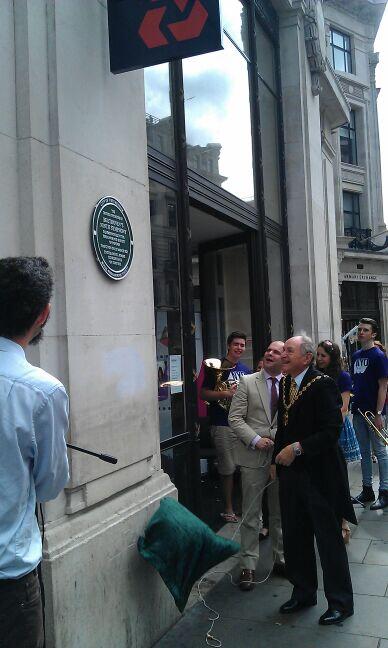
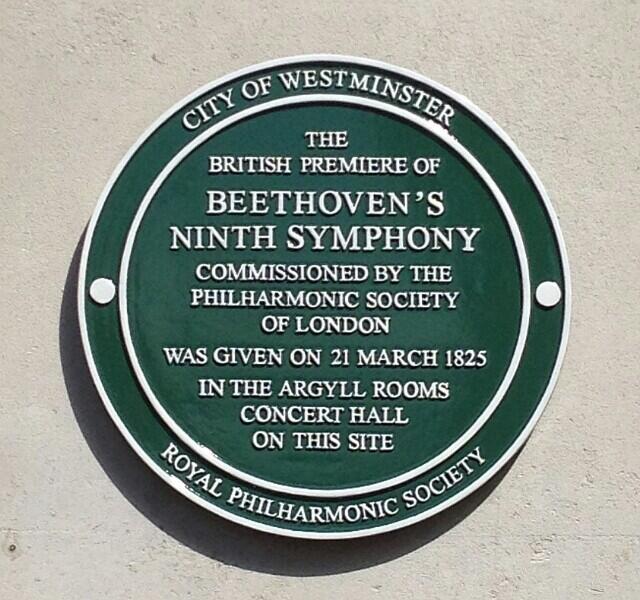
A green plaque commemorating the first UK performance of the RPS's most famous commission, Beethoven's 9th Symphony, was unveiled yesterday on Regent Street. The plaque marks the former site of the New Argyll Rooms, which is now a NatWest bank. It was unveiled by RPS Chairman, John Gilhooly and Councillor Michael Brahams, Deputy Lieutenant of Greater London. The occasion was accompanied by a new fanfare by Bertie Baigent, a young composer from the National Youth Orchestra, performed by players from the NYO. 

Then it was straight off to the Royal Albert Hall for more Beethoven 9 celebrations with the NYO at the BBC Proms. (Take a look at last week's blog, where NYO musicians talked about the unforgettable experience of playing at the Proms). Beethoven's 9th Symphony was preceded by the world premiere of Frieze, a Beethoven-inspired RPS co-commission by English composer Mark-Anthony Turnage. 
A bow for Beethoven Bust

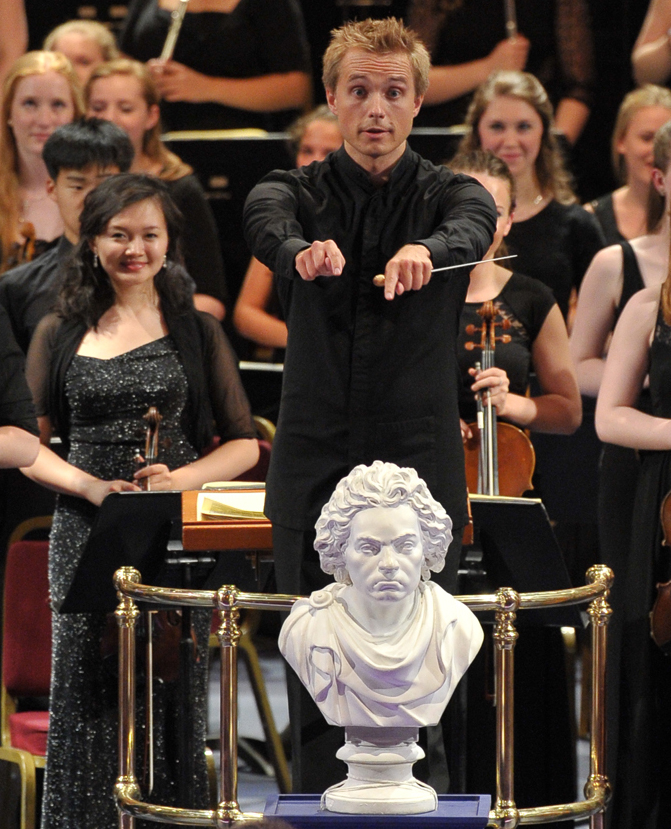
The NYO shared the Royal Albert Hall stage with singers from across the British Isles - and of course the Society's bust of Beethoven, who kept an eye on proceedings from his perch in front of Vasily Petrenko's podium. Not so dissimilar, then, to the 1824 premiere of the 9th Symphony in Vienna, when the by-then profoundly deaf composer stood behind the conductor to guide the tempo. Beethoven was oblivious to the applause which erupted at the end of the work, until one of the soloists turned him around to face the audience. 

Rapturous applause from a packed Albert Hall also greeted last night's performance - a fantastic end to our Beethoven Super Sunday. Huge congratulations to all the performers!

Missed the Prom? You can listen on IPlayer until 17th August. The concert will also be broadcast on BBC4 in 2 parts on 18th August and 6th September. 

Tuesday, 6 August 2013

NYO and the Proms

On 11 August, the National Youth Orchestra will return to the Proms, along with the National Youth Choir, Irish Youth Chamber Choir, and Codetta.  Nearly 400 teenagers will perform on one of the world’s most famous stages, forming a fitting spectacle for a glorious celebration of the commission of Beethoven’s ninth symphony.


NYO are enormously lucky to be invited to the Proms again this year, and it is frequently the highlight of any member’s musical year.  Some of our players have had the fortune to already have played with the orchestra at the Proms over the last couple of years, so who better to tell the story than themselves?  During our rehearsals this summer, we asked what makes this event so special, and what they’re looking forward to this year:


‘Playing at the Albert Hall is an incredible experience in itself, but joining with the magnitude of massed choirs really takes it to the next level. Add Beethoven 9 into the equation and you get a really explosive combination!’ Anna Lapwood, harp

‘It's an incredible experience playing at the BBC Proms. The atmosphere backstage before a concert is electrifying and like no other concert venue, not only because the concert is recorded for both live radio and television, but also because NYO always attracts the most passionate, excited and youthful of audiences to the concert series! The orchestra really up their game for the appearance at the RAH and you can feel the energy and passion coming from 170 young musicians putting their heart and soul into the music...it's really something special to be part of!' Michael Devlin, clarinet

‘Performing in the Royal Albert Hall really is an amazing experience. To think of all the amazing artists who've graced the stage before makes me cherish every minute I am there.’ YeYe Xu, violin


‘It’s exhilarating to be part of this meeting of the old and the new: a dynamic youth orchestra in a historic concert hall, with a programme ranging from the classic to the cutting-edge. Nothing is more thrilling than being part of the Proms, during the height of summer, seeing so many people enjoying the music that I hold so close to my heart.'  Fien Barnett-Niefs, harp

Monday, 5 August 2013

On tribes and heartbeats

Dobrinka Tabakova on the inspiration for Pulse

In mid-July I went to a concert as part of the SouthBank Festival of Neighbourhood - it celebrated 25 years of the gamelan at the SouthBank. The concert was absolutely fantastic - the dancing, shadow puppets, singing, playing. It is no wonder that Jaap Kunst said ‘Gamelan is comparable to only two things, moonlight and flowing water… mysterious like moonlight and always changing like flowing water…”. Reflecting on the event and the festival, I thought back to the initial conversations Tom Hutchinson from the RPS and I had about this project, and how we discussed possible themes and ideas, which would fit with the wide-reaching aims of the New Music Biennial alongside the Commonwealth games in Glasgow in 2014.


The idea we kept coming back to was that of living in a city. More than half the world’s population lives in cities. Musically, for me this immediately suggested fast paced, energetic, almost punchy music. I could almost hear the colours which I wanted, and percussion and piano were strong, prevalent sounds. A few years ago, I worked with the SouthBank gamelan players and was really keen to work with them again. The subtle friction between the different tuning of the gamelan together with Western tuning appealed to me. I felt there was a parallel there with how the two tunings blend and how different people fit to form the large living organisms - cities, which so many of us inhabit. The working title became ‘My Pulse, My Place’.

At the heart of this project is a collaboration between film and music. I had met filmmaker Ruth Paxton last November in Nottingham, at the screening of her film ‘Rockhaven’ to Brian Fernehough’s Prometheus score which was part of the Royal Philharmonic Society’s Encore scheme. Her film had strong images, flowing shots and there was something poetic and musical about the pace, even if the main characters were heavily tattooed boxers. I was excited to see how our two worlds would fit and the process of working with a filmmaker.

Before our first meeting in May, I had a general sound of what the music would be, having chosen and agreed on the instruments: piano, percussion and gamelan. I thought a great deal about Time. Both Ruth and I deal with structures in time, how is a story paced, what is the rhythm of a single shot; what is the shape of the composition. Linking in with the sport element, time is often a measure of achievement. Our hearts beat close to the rhythm of the second hand of the clock, etc.

We often hear people describing different cities - they have a certain pulse, life has a certain pace… I wanted the music to have this sense of a unifying pulse all the way through, so I brought a metronome along to our meeting.


I loved how both Ruth and I had this starting idea of the city and how in the first meeting, we brought our visions and ideas of what we associate with the concept. What struck me were some of the stories Ruth mentioned - our etiquette on public transport, the spark and embarrassment of catching someone’s glance, holding on to a rail and accidentally brushing your hand against someone else’s. How such small moments can bring people together and can be so powerful. The story which Ruth told and really stayed with me was of how a boy was saved from drowning in the sea in Australia by people from the beach making a human chain and pulling him out to safety. Ruth mentioned that she wanted to make a film with a positive message about humanity. I felt inspired to celebrate in the power of what people can do when we do things together.


In the first meeting, Tom, Ruth and I agreed that it was important to choose the title, or at least agree on some words, which we felt were important. After a long brain-storming session, covering all that we had been thinking about in the months between submitting the application and having our first working session, we came up with really strong words, but there was one word we kept coming back to: PULSE. We had our title.

Dobrinka Tabakova

Thursday, 11 July 2013

An interview with the Beethoven Bust

A quick nap at the RPS office

The RPS commissioned Beethoven’s Ninth Symphony for the sum of £50 and gave the first performance in the UK on 25 March 1825 at its concert hall in Regent Street, London. Two years later, when Beethoven was on his deathbed, the Society sent him £100. Beethoven received this gratefully, expressing his thanks to ‘the Society and to the whole English nation’.

Schaller’s iconic bust of Beethoven was given to the RPS (then the Philharmonic Society) in 1870 by Fanny Linzbauer in recognition of its generosity towards the composer in times of need. It was displayed on the concert platform of every Society concert thereafter; a tradition which has been re-established this year as part of the RPS Bicentenary celebrations. Earlier today, our Beethoven Bust took time out of his hectic travelling schedule to update us on his news.  

Beethoven Bust, thank you for finding the time to chat. I hear it’s been a busy year for you.

It has indeed! I’ve been appearing at concerts all over the country! I’m just back from the Aldeburgh Festival and am looking forward to a few days tanning in the sun; I’ve been looking a bit pale recently.

I’m glad you’re finding a moment to put your (figurative) feet up amidst the RPS200 celebrations.  

You can talk - you’re interviewing a statue…

Well I spend so much time lugging you around, it seemed only right to get to know a bit more about the man behind the stony exterior.

I’m actually made of plaster. I’m a replica of the bust that was given to the Society and I was placed on the platform of every Philharmonic Society concert from 1871 onwards. I did have a brief spell of retirement though, after the last concert series was given in the 1980s.


Give us a smile! Bryn Terfel drops in to say hello.
You’re looking very good considering you’re over 100.

Well I need to stay in shape; people keep wanting to have their photo taken with me. Just the other day that lovely Bryn Terfel dropped by to say hello, and I was spoilt rotten by the Classic FM when I visited their studios. Don’t believe me? You’d better take a look at my Pinterest page

You have a Pinterest page? Next you’ll be telling me you’re on Facebook too.

Facebook?! That’s so last century. It’s all about Twitter these days. My @beethoven_bust account already has quite a following.  


Me and Myleene: a Klass act

So when you’ve had your fill of tanning and tweeting, what’s next on the agenda?

Speak up! I’m a little deaf. What’s that you’re suggesting? A bender? What would be the point of that? I’m already plastered.

Haha very funny. I said tell us about your AGENDA…

Oh, that’s more like it. Well I’m very excited about appearing at the BBC Proms. My aged friends at the RPS are celebrating their 200th birthday with a special free Prom on 11 August, and what better piece to include than my very own Ninth Symphony! I’m not sure where I’ll be sat though; apparently I’ve got competition from Sir Henry Wood. It’s going to be the battle of the busts…


The RPS's free Birthday Prom will feature the Society’s most famous commission, Beethoven’s Ninth Symphony, and a new work, Frieze, from British composer Mark-Anthony Turnage co-commissioned the RPS, BBC and New York Philharmonic. The concert will be broadcast live on BBC Radio 3. For more information, please visit the BBC Proms website.

Is Beethoven Bust coming to a venue near you? Take a look at all the concerts and events we have planned for the second half of 2013 in our online brochure.

You can read more about the Beethoven Bust -and avoid the awful puns - on our website

Wednesday, 19 June 2013

Flippancy and Music

A new blog post from Tom Coult, one of five recipients of the 2012 RPS Composition Prize.


Interviewer: ‘How many people – who labour in the same musical vineyard in which you toil – how many are ‘protest singers’, that is people who use their music and use the songs to protest the social state in which we live today…the matter of war, the matter of crime or whatever it might be?’
Bob Dylan: ‘How many?
Interviewer: ‘Yes, are there many?’
Bob Dylan: (serious) ‘I think there’s about…136’
Interviewer: (perplexed) ‘You’d say about 136? Or you mean exactly 136?’
Bob Dylan: (impishly) ‘It’s either 136 or 142…’


You’d have thought that, being lucky enough to be given the opportunity to work with the Philharmonia Orchestra as part of their Young Composers Academy, and to be commissioned by the Royal Philharmonic Society to write a piece for the Royal Festival Hall, I would take it rather seriously. And of course I have in most senses – it’s been a brilliant experience to workshop my music with Philharmonia players, to watch them rehearse, to receive guidance on my score from Unsuk Chin and Simon Bainbridge, as well as being sat down for chats with York Höller, Luke Bedford and Esa-Pekka Salonen. But in fact the thing that’s been occupying my mind most while writing my piece has been flippancy


Flippancy, especially as expressed in art, is a kind of levity and frivolity delivered with a subversive mock-seriousness – a matter-of-fact insincerity that is charming and disarming in equal measure. To be flippant is to indulge the noble urges to dodge every serious question, to prize wit over sincerity, and to take hedonistic delight in obtusely counter-intuitive formations. And if those urges don’t sound very noble at all to you, then perhaps you have misread my flippant tone…


It also implies a certain mode of reception that attracts me as a composer. Language is normally used to inform or persuade – reaching out to the receiver and using rhetorical techniques to affect them. Similarly, the archetypical post-Beethoven piece of music attempts to move the listener, to get her heart racing and her hair standing on end. Above all, it has a sense of meaningfulness – whether this meaning is expressible in words or not. The flippant statement in music or language, however, merely sits there, sublimely unconcerned with the listener’s opinion of it. It is an impassive object of elegant meaninglessness – a beautiful crystal to be admired from afar. Rather than reaching out to the listener, it reclines on a chaise longue, perhaps gently fanning itself, daring anyone to ignore its exquisite charms. 


It is the flippant impulse that underlines the work of some of my favourite artists and writers. Lewis Carroll’s Alice books contain some of the most flippant characters in all of literature – Alice (not immune to some high-grade whimsy herself) has her every honest question and inquiry met with stony but fantastical disingenuousness by a succession of animals, royalty and unhinged milliners. The paintings of René Magritte, the drawings of Saul Steinberg and the poetry of Spike Milligan all cultivate a kind of ecstatic nonchalance. When a succession of earnest interviewers asked a succession of earnest questions to what they assumed would be an earnestly political singer-songwriter in 1965, Bob Dylan’s responses were sometimes frivolous, sometimes disdainful, but always immaculately flippant. 


In classical music, though I can perhaps detect some of the same spirit in Haydn, it is difficult to identify flippancy in composers before the nineteenth century because there was not the same expectation of seriousness. The work of art for the nineteenth century, however, had a transcendental, metaphysical significance – a quasi-religious orientation toward the noumenal that made the sincerity of the composer paramount. Many masterpieces, of course, were produced with this sensibility, but it took until the early twentieth century for a composer to mount a sustained challenge to this high-minded orthodoxy. Among Igor Stravinsky’s many musical innovations, then, I think it is his cultivation of artistic insincerity that is one of the most radical. Stravinsky’s music from the 1920s onwards is delightfully matter-of-fact – a succession of musical objects that hold the listener at arm’s length (but whose elegance and wit are highly intoxicating to the listener that’s willing to forgive the slight). 


There are other great purveyors of musical impishness – including the person who has overseen the Philharmonia’s Music of Today series and our Young Composers Academy, Unsuk Chin. She no doubt learnt some of this spirit from her teacher György Ligeti, from whose mischievous pen flowed some of my all-time favourite musical flippancy. And London has recently been treated to the puckish charms of Gerald Barry’s music through his treatment of the flippant work of art par excellence – Oscar Wilde’s The Importance of Being Earnest. Wilde – surely the most brilliantly, elegantly, luxuriously flippant writer ever to put pen to paper – said of his play that it is ‘exquisitely trivial, a delicate bubble of fancy, and it has its philosophy…that we should treat all the trivial things of life seriously, and all the serious and studied things of life with sincere and studied triviality’.


So while writing my piece, entitled ‘Four Perpetual Motions’, I was trying to blow my own bubble of equivalent delicacy and fancy. I sketched a number of short miniatures – small bits of characterful and colourful music that eschewed ‘dramatic’ forms and would simply start, play a little game, then finish. While it would be rather grandioise to call it in any way subversive, I felt that this approach would be a nice foil for the apprehension I felt about my music being performed in the august setting of the Royal Festival Hall. After a workshop with Rüdiger Bohn and the Philharmonia players in March, I whittled my miniatures down to the four that now constitute the finished piece. The first three are, I would say, properly flippant. They aim for elegance, wit and matter-of-factness in tone – if the listener has a positive reaction, they are likely to be charmed rather than moved. 


I may have faltered in my aims when it came to the last movement, however. I don’t know what happened, but while it’s not exactly emotionally sincere, it seems to have developed a desire to be taken a bit more seriously than its more childish siblings. This more self-important eldest child is the movement I worry most about – will the audience find something worthwhile in it? Will they be moved? Or will it fall flat, making a mockery of its pretensions? 


While I adore flippancy and insincerity, I do recognise that at times they are merely methods of sidestepping these important concerns, a shield from the exposing experience of putting something of yourself sincerely into a piece of art and having it appraised by an audience. Perhaps, like all the great artists that I mentioned above have done, I will at some point set myself some loftier ambitions and attempt something serious, even profound. 


Perhaps not, though – after all, you shouldn’t take everything I say seriously…


Tom Coult
www.tomcoult.com

Tom Coult is one of five winners of the 2012 RPS Composition Prize. His piece 'Four Perpetual Motions' will be premiered by members of the Philharmonia conducted by Rüdiger Bohn at the Royal Festival Hall on Thursday 27th June, 6pm. Please click here for more details. 

Monday, 10 June 2013

RPS200 in full flow

We are delighted to introduce the online version of our brand new Bicentenary programme booklet, listing all the celebratory events taking place between July and December.


*************************************************
Summer highlights include a special free BBC Prom on 11 August as we continue our bicentenary celebrations at the Royal Albert Hall. The Prom will feature Frieze, a new work from British composer Mark-Anthony Turnage, and the Society’s most famous commission, Beethoven’s 9th Symphony.

What are you looking forward to most?

Tuesday, 14 May 2013

RPS Music Awards 2013

Our blog might have fallen rather silent over the last few months, but the RPS certainly has not!


The annual RPS Music Awards, the ‘Oscars’ of live classical music, took place at the Dorchester Hotel on 14 May. We were thrilled that Dame Janet Baker CH presented the Awards to this year's winners across the 13 categories:

Audiences and Engagement: Universe of Sound (Philharmonia Orchestra)
Chamber Music and Song: Music in the Round
Chamber-Scale Composition: Rebecca Saunders: Fletch
Concert Series and Festivals: New Music 20x12 (PRS for Music Foundation)
Conductor: Kirill Karabits
Creative Communication: Classic FM
Ensemble: Britten Sinfonia
Instrumentalist: Steven Osborne
Large-Scale Composition: Gerald Barry: The Importance of Being Earnest
Learning and Participation: Cycle Song (Proper Job Theatre Company and Scunthorpe Co-operative Junior Choir)
Opera and Music Theatre: Mittwoch aus Licht (Birmingham Opera Company)
Singer: Sarah Connolly
Young Artists: Heath Quartet

Congratulations to all of our winners and shortlisters!


RPS Award winners at the 2013 ceremony


During the ceremony, we also marked our bicentenary by presenting five special RPS Honorary Memberships. These international music makers have put music at the heart of some of the most challenged communities in the world, supported young musicians and made a profound difference to diversity in music making. The short videos below offer a a window onto the vital work of these extraordinary people.


Our new Honorary Members are:

►  Armand Diangienda, a former airline pilot who founded a symphony orchestra in one of the poorest cities on earth, Kinshasa, DR of the Congo

►  Dr Ahmad Sarmast, the founder of Afghanistan’s first national music school in Kabul

►  Rosemary Nalden, British viola player and founder of Buskaid, who persuaded distinguished musicians to busk at British railway stations to raise funds for a string project in South Africa, and now directs the thriving stringed instrument school in Diepkloof, Soweto.

Our new RPS Honorary Members
►  Ricardo Castro, International pianist (and former winner of the Leeds Piano Competition) who established a flourishing youth music programme in Bahià, Brazil.


Aaron P. Dworkin, the founder of the Sphinx Organization, which gives opportunities and assistance to aspiring Black and Latino musicians in the USA. Sphinx’s mission is for classical music to embrace the diversity inherent in the society that it strives to serve.

Thursday, 8 November 2012

Counting down to RPS 200: The Bicentenary Launch


From Beethoven’s 9th to the Argyll Arms, the Royal Philharmonic Society has always recognised great bars…

…so what better venue than the Argyll Arms to launch our programme of Bicentenary events yesterday morning? 19th century Philharmonic Society musicians almost certainly drank at this historic pub following concerts at the Argyll Rooms in Regent Street, which included the first UK performance of the Society's most famous commission, Beethoven's 9th Symphony.

The legacy of Beethoven remained much in evidence yesterday -not least through the dusting down of our very own Beethoven bust, which had pride of place on the bar. Alas, he failed to raise a smile even for one of his greatest interpreters, Alfred Brendel (pictured here). We were thrilled that Brendel (who was awarded the RPS Gold Medal in 1992) and wonderful soprano Susan Bullock (2008 RPS 'Singer' Award Winner) were able to join us at the launch and share a few words. 

“Please keep commissioning composers, keep supporting musicians, keep talking about music and keep championing excellence”, Brendel urged, whilst approving of us “growing old disgracefully”! Follow this link to take a look at our programme of concerts – featuring several high profile commissions – debates, talks and exhibitions, and we think you’ll agree Brendel won’t be disappointed! We hope you won’t be either. 


Friday, 5 October 2012

Mitsuko Uchida Recital for the RPS Bicentenary Appeal

A very special Schumann recital with Mitsuko Uchida at which we raised £25k for the RPS's Bicentenary Campaign. 

A huge thanks to all those who attended and donated money, to Sir Vernon & Lady Ellis for hosting the event at Queens Gate Terrace, to event sponsor Rosenblatt Recitals, and of course to the wonderful Dame Mitsuko Uchida.


Tuesday, 18 September 2012

200 years at the heart of music - and a new logo to celebrate!


At long last, the brand new RPS logo has been let loose on our website, emails and stationery – we didn’t stretch to clothing, I was always told that red and pink don’t go together. Launched in conjunction with our bicentenary celebrations, this new logo has caused a bit of a headache. How do you best encapsulate the values and outlook of an organisation in that tiny favicon at the top of your screen? The decisions are endless: straight lines or curves, abstract or pictorial, how much text, which font… and that’s before you even bring colours into the equation. Get it wrong and you’re left with something that distorts your image – like a bad haircut, but harder to get rid of.

And then there’s our name, not the most malleable collection of words with a whopping great ‘Philharmonic’ bang in the middle of it. But that very word is central to the Royal Philharmonic Society’s purpose:  philharmonic: adj. devoted to music; music loving - you can’t put it plainer than that! So without wanting to prescribe too literal an interpretation of our logo, if you’re seeing hearts you’re probably on the right wavelength. (Then again, some particularly creative viewers have also read it as a bird’s-eye-view of a grand piano, so let your imagination run wild…) It’s been a long journey but we love the end result, and hopefully you’ll be spotting it around a lot more as the countdown to RPS 200 begins in earnest! 

Helen Pearce


Monday, 25 June 2012

Musical talent is not a postcode lottery - John Stephens calls on educators and musical professionals to support the next generation


John Stephens OBE has been awarded Honorary Membership of the Royal Philharmonic Society in recognition of his outstanding contribution to music education.  

For over 60 years he has been at the forefront of music education, including as Staff Inspector of Music for ILEA, Vice Chair of the Music Working Group for the National Curriculum and as a music education advisor to the Royal Opera House, Wigmore Hall, London Symphony Orchestra, Trinity College of Music, Youth Music and many other organisations.  

In this blog, he reflects on how educators and professional musicians can, and must, work together to nurture incipient talent:

There is a great reservoir of latent musical talent in our schools, conservatoires and universities and I have been privileged to see that develop over the last sixty years.  
That talent flourishes when music educators and professional musicians come together to support, nurture and inspire - but most of all to make music together. 
Orchestras, bands, choirs and ensembles representing every genre and style can be heard in schools where governors and head teachers have ensured that music is firmly rooted in the curriculum. 

The National Plan for Music Education has now replaced a Music Manifesto and 'Music Hubs' is the latest jargon for partnerships and collaborations between teachers and professionals. With a reducing level of public funding from the Arts Council, the Hubs are charged with seeking resources elsewhere; a daunting task in present economic circumstances. 


Maintaining opportunities for today's young musical talent to be encouraged and developed is going to present a greater challenge than that known to previous generations of music educators.


Musical talent is not prescribed by parental income or post code; it is not confined by either gender or ethnic background; it is not restricted by musical genre or idiom. Quite straightforwardly, it is at the heart of every civilised community. 

Politicians and parents; teachers and musicians; we must all ensure that young people have the opportunity to develop their talent. We want them when they leave school to say, as do I now, 'Thank you for the music'.

John will be presented with RPS Honorary Membership at the LSO Discovery Celebration Concert on 28 June at the Barbican, surrounded by music makers from local schools and musicians of the London Symphony Orchestra.  Jeff Moore’s ‘River Journey’, commissioned by John Stephens especially for the LSO and primary schools close to LSO St Luke’s, opens the programme. More details


Lucy Anderson and Queen Victoria's Piano


Following on from our Jubilee musings earlier this month about the Royal Roots of the RPS, this little article from Zee News India caught our eye.  Who knew that Queen Victoria was a passable pianist?  Or that her teacher was Lucy Anderson - the first woman pianist to play for the Philharmonic Society?  Lucy Anderson appeared 19 times between 1822 and 1862, and was the first pianist to play Beethoven's Emperor Concerto with the Society: 


Kolkata  June 21, 2012: On World Music Day, music aficionados of the city got a glimpse of the Victorian era masterpiece - the grand pianoforte on which the Queen Victoria honed her skills - after it was put back on display at the Victoria Memorial Thursday.

The instrument, carved out of rosewood and manufactured by noted French piano makers Sebastian and Pierre Erard, was put inside a glass case at the Royal Gallery of the museum after a gap of almost two decades.

One of the most illustrious French piano manufacturers of all time, Sebastian Erard began building superior harpsichords in Paris in the 1700s. His instruments were so renowned that he obtained a license from Louis XVI to produce pianos for the French court...  Read more


Friday, 1 June 2012

Jubilee Special: Rediscovering our Royal Connections

As Diamond Jubilee fever sweeps through England and the country is engulfed by bunting and Union Jacks, what better time to give a nod to the RPS’s royal affiliations – the clue, after all, is in the name. The Society gave its first concert “under the immediate patronage of His Royal Highness the Prince Regent” in 1813. Many members were chuffed to see the court and aristocracy in attendance at the Society’s early concerts.  The financial benefits of this patronage, however, were questionable; His Royal Highness was not even expected to pay for his ticket. The Dukes of Cumberland, Sussex and Cambridge also regularly made appearances; the last was known to be passionate about music, in particular that of Bach. As it happens, the current Duke and Duchess of Cambridge chose to kick off their wedding last year with a bit of JSB too, suggesting good taste in music as well as dresses.

Monarchs have come and gone (albeit not particularly quickly, as this weekend’s Diamond Jubilee celebrations cheerfully bear witness to!) but the Royal Philharmonic Society, soon to celebrate its 200th year, has endured. In recognition of its centenary year in 1913, the Society was granted official permission to add Royal to its name. It now enjoys the immediate patronage of Her Majesty the Queen, to whom the RPS sends the warmest wishes on her Diamond Jubilee! In 1988, as the Society celebrated the 175th year of its foundation, Her Majesty even came to see some of the items in the RPS archive. Here she is taking a good look. 

With the Jubilee concert and the Thames Jubilee Pageant to look forward to this weekend, it looks like Her Majesty is helping to sound the trumpet for music! The promise of a four-day weekend, it seems, is temporarily doing away with good old British cynicism, so I’ll be joining in the fun and games, even if we haven’t stretched to bunting in the office.  

Helen Pearce

Wednesday, 25 April 2012

Nikolaus Harnoncourt Receives RPS Gold Medal

Harnoncourt receives his award from the RPS Chairman
Nikolaus Harnoncourt has become the latest recipient of the prestigious RPS Gold Medal. The presentation took place on-stage at the Barbican on Sunday 22 April, after the maestro had conducted a performance of Beethoven's Missa Solemnis with the Royal Concertgebouw Orchestra of Amsterdam.

The concert programme was particularly apt; the RPS Gold Medal was created to commemorate the centenary of Beethoven’s birth and celebrates the close relationship between the Society and the composer. Harnoncourt's performances and recordings of Beethoven’s work have achieved a legendary status. Sunday's concert and presentation, which was met with a standing ovation, reminded us why.


Popular Posts